By South Asia Solidarity Network – SASN (USA)
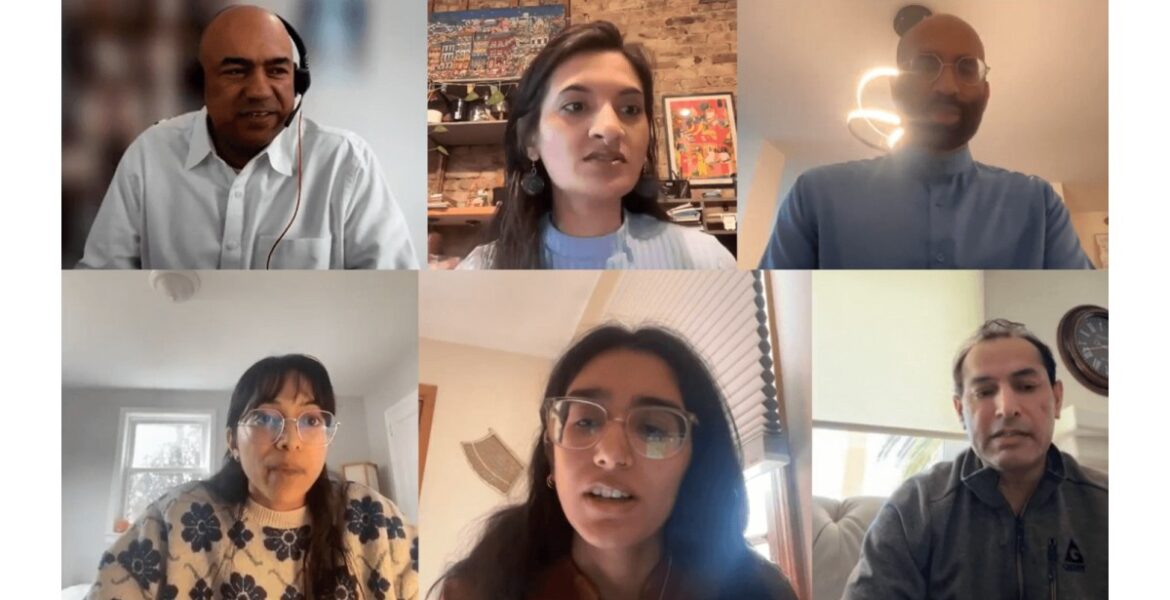
The South Asia Solidarity Network (SASN) organized a panel discussion on March 7, 2026, to discuss how South Asian immigrants can organize politically at a time marked by escalating global conflicts and wars, an ongoing genocide, and sharply intensifying anti-immigrant policies in the United States. Moderated by SASN organizer Farhad, the panel brought together organizers from different parts of the U.S. who argued that meaningful political work must be rooted in solidarity with other oppressed communities and connected to anti-capitalist struggles in South Asia. Speakers emphasized long-term base building, political education, and a material analysis of how global capitalism shapes migration and diaspora politics.
Minahil Khan of South Asian Left (SALAM) explained SALAM’s efforts to build internationalist consciousness through campaigns such as targeting Tata Consultancy Services for its involvement in Israeli military infrastructure. She added that SALAM uses these campaigns to connect issues like Hindutva and Kashmir with Palestine, while grounding its work in structured political education and sustained organizing.
Jahan Chaudry of the Saturday Free School for Philosophy and Black Liberation argued that the Black proletariat remains central to any democratic transformation in the United States. Drawing on W.E.B. Du Bois and Martin Luther King Jr., he described how a privileged, post-1965 layer of the South Asian diaspora has been positioned as a “wedge group” that stabilizes U.S. imperial institutions. He framed the current crisis as moral as much as political, calling for a renewed “battle of ideas” to realign South Asians with anti-imperialist and multiracial democratic struggle.
Lekha Kanchinadam of the Rutgers University Anti-Caste Collective (RUACC) argued that the public university is a core site of organizing shaped by caste, class, and visa precarity. RUACC builds community on campus and aims to educate Rutgers University students about caste. RUACC members have also been working towards building coalition around sanctuary campus demands, solidarity work with pro-Palestine groups, supporting international graduate students, and pushing unions to move beyond symbolic resolutions toward meaningful collective action. She described demands like “Papers for All” as essential to challenging the logic of borders rather than reforming the existing immigration regime.
Isra, a law student organizer in Chicago, outlined efforts to build a political home within the legal education environment that often channels South Asians into corporate or prosecutorial careers. Her coalition organizes for campus-based immigrant protections, advocates the use of law school clinics to support vulnerable students and community members, and advances Palestine Solidarity efforts through BDS resolutions targeting firms complicit in the occupation. She emphasized the importance of training future lawyers to work collaboratively with grassroots movements rather than elite institutions.
Sajjad, a founding member of SASN, grounded the discussion in the political economy of migration, arguing that South Asian immigration is a direct outcome of centuries of imperialist exploitation, from colonial famines to IMF policies that destabilize economies across the Global South. While acknowledging the presence of a South Asian elite aligned with U.S. power, he stressed that most South Asian immigrants are working-class and share common interests with the broader U.S. working class. SASN’s aim, he stressed, is to build a transnational network linking diaspora organizers with progressive movements in India, Pakistan, Bangladesh, Sri Lanka, and beyond.
During the Q&A, panelists addressed the contradictions of the “model minority” narrative and the need to engage working-class South Asians without moralizing or alienating them. In response to other questions, panelists emphasized political education and collective transformation. They further pointed to the importance of making internationalism materially concrete, citing examples where local tenant struggles intersect with global patterns of displacement. The event closed with a shared commitment to deepening collaboration across organizations and geographies.
You may also like
Leave a Reply